
by Dr Karen Singarayer, Vice Chair of the Catholic Union
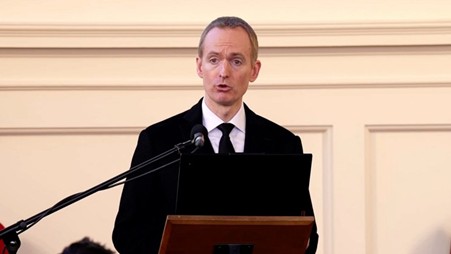
Matthew Harvey Sanders delivered the keynote address ‘AI, the Future of Work and Christian Discernment’ on 20 May 2026 as part of the series of talks on the theme of ‘Staying Human’ for Together For The Common Good.
Mr Sanders is the CEO of Longbeard and Creator of Magisterium AI, Vulgate AI and Ephrem AI.
The ecumenical audience comprised of a cross-section of representatives from the Catholic Church, Anglican Church, Methodist Church, other churches, Judaism, the tech industry, media, law, medicine, charities etc.
Bishop Paul Hendricks, Lead Bishop for Artificial Intelligence (AI) for the Bishop’s Conference of England and Wales and Monsignor John Armitage were also present along with other members of the clergy.
Mr Sanders began by inviting the gathered to ponder two questions about work. What does work do to human beings? What do human beings receive from work? He reminded the audience the 135th anniversary of Rerum Novarum, the encyclical by Pope Leo XIII had only been a few days earlier. Mr Sanders noted that it was not a coincidence that this remarkable document was published two years after Cardinal Manning’s support for and intervention in the Great Dock Strike of 1889. Cardinal Manning is considered to have been a key contributor to the papal encyclical which marks the beginning of modern Catholic Social Teaching.
Matthew Sanders shared many statistics that underlined the reality of AI, its use and far- reaching consequences. The reader will realise that there are ‘unknown unknowns’ to consider.
Mr Sanders highlighted an important finding elucidated by the Stanford 2026 AI Index Report which identified that productivity gains were weaker or negative in tasks requiring judgement.
Mr Sanders relayed another statistic that 73% of AI experts compared to only 23% of the public thought the impact of AI on society was positive. He suggested despite this significant and unprecedented result, AI was being driven forward and promoted.
The situation was described by Mr Sanders as ‘a political and pastoral emergency waiting to happen’. He added, ‘Economic disruption needs capability and we have capability here.’
Mr Sanders continued that white collar workers would be substantially affected with a predicted 20% fall in software developer jobs in the USA by 2028.
Mr Sander informed the attendees that Mustafa Suleyman, Microsoft AI CEO predicted earlier this year that most white collar jobs will be automated in twelve to eighteen months.
Sam Altman, OpenAI CEO has said Artificial Superintelligence (ASI) could arrive within two years. Mr Sanders explained that presently one person using AI could theoretically do the work of five people however with Artificial Generative Intelligence (AGI) that figure increases to between one hundred to two hundred.
Mr Sanders continued that Andrew Bailey, Governor of the Bank of England has warned that job displacement with the widespread adoption of AI, could rival those at the time of the Industrial Revolution.
A particularly ominous quote from Dario Amodei, Anthropic CEO that AI is not replacing work but AI is ‘a general labour substitute’ was shared by Mr Sanders.
Referring to Pope St John Paul II’s encyclical Laborem Exercens published in 1981, Mr Sanders recognised it as a surprisingly relevant document regarding the dilemma with AI. Citing objective and subjective dimensions, Mr Sanders shared that subjective dimensions are more important.
Pope Leo XIV highlighted when speaking to health professionals in November 2025 that the medical profession cannot be reduced to reaching a diagnosis only but requires the ability to communicate and be close to others. The Holy Father has spoken of the importance of having a relationship with those experiencing suffering.
Mr Sanders identified that remaining human was paramount and listed four considerations:-
1) Judgement under a moral weight eg a doctor’s decision to treat if cure is not possible
2) Presence with the suffering eg nurses at a bedside, teachers alleviating distress, priests in a confessional
3) Formation of conscience and character eg teaching to tell the truth when truth is costly
4) Given a community eg forming friendships and relationships within parishes and with neighbours.
Matthew Sanders called for every formation programme, seminary programme and lay leadership programme to train for the above.
He supposed that the UK economy was more structurally exposed as it has a large service industry comprising finance, law, media and education sectors for example. He compared the UK with Germany which is known for its manufacturing sector and said that London and the Southeast is more exposed to AI job displacement than other parts of the country.
Mr Sanders surmised that the Church offers structure, community, vocations and a shared purpose to help preserve what is precious in humanity.
Mr Sanders called for the Bishops and Pastors to begin preparing people now. He underlined the necessity of being aware of young adults losing their first jobs, to preach about workers’ vocation and to treat the parish as the most important anchor for neighbours and community.
Pope Leo noted in 2025, ‘Human beings and called to be co-workers in a work of creation….’
Mr Sanders called for Academics to play their part and for all to find the young person in their life and cultivate their particular understanding that dignity doesn’t depend on their economic output.
Although Mr Sanders stated that the link between human work and human survival has been severed and that for the first time in civilisation, working primarily to survive may be ended.
Mr Sanders concluded that he was optimistic about the future and that the Church had a key role to play.
This was a timely and topical lecture before the publication of Pope Leo XIV’s encyclical ‘Magnifica Humanitas’ on 25 May 2026.
Read the text of Matthew Harvey Sanders’ speech AI, the Future of Work and Christian Discernment. This is the fifth in Together for the Common Good’s Staying Human series where Matthew Sanders confronts the realities of the new industrial revolution now unfolding through artificial intelligence: its rapid timeline, its profound effects on work, livelihoods, and meaning. Drawing on his practical experience of the industry and on a deep understanding of the Catholic Social Teaching tradition, he shows what must be done to uphold human agency and mitigate the risk of social unrest. Sanders sees the local church not as a fading institution but as the essential bulwark to preserve conscience, vocation and belonging. This sobering lecture reveals the vital need for formation in authentic anthropology, and the deeper purpose of Christian witness in our time.