A Paradox, a Dilemma, and a Mystery:
St Benedict’s Message for Europe in 2025
Talk given in Worth Abbey on 12 July 2025
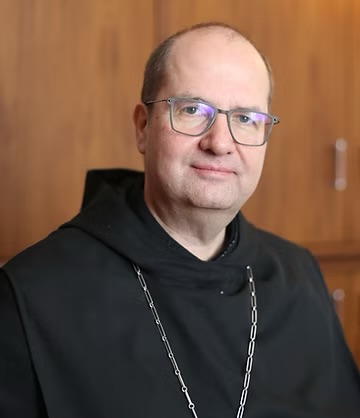
By Jeremias Schröder OSB, Abbot Primate
Introduction
Good afternoon. Thanks for being here today. And thanks for having invited me.
This is quite a daunting audience – there are monks here, notoriously hard to please, the Lay Community of St Benedict, the Catholic Union, friends of Worth Abbey and others who are interested in our great topic: the impact of St Benedict in 2025.
Many of you have already heard two great talks in the course of this past week: Baroness Sheila Hollins about Benedictine values for today, and Dr Charles Insley about the Benedictine roots of English political civilisation, suggesting that the monarchy was Benedictinised in the tenth century and has somehow remained so until today. Both of these are topics very close to my heart, and topics I would love to talk to you about. Or would have loved to. But you have heard them already.
So, instead I will talk about a Paradox, a Dilemma, and a Mystery.
The Benedictine Paradox
We speak of St Benedict as one of the fathers of Western Civilization. 60 years ago, when Pope Paul VI declared him the principal patron of Europe, he described that rather poignantly under the images of the Cross, the book and the plough:
“With the Cross, that is with the law of Christ, he gave consistency and development to the ordering of public and private life.”
“With the book, that is with culture, he safeguarded, with providential care —at a moment when the humanistic heritage was dissolving—the classical tradition of the ancients, passing it on intact to posterity and restoring the true reverence for knowledge.”
“It was with the plough, through the cultivation of the fields and similar undertakings—that he succeeded in turning barren, overgrown lands into richly fertile fields and charming gardens.” (Pope Paul VI, Pacis Nuntius, 1964).
This is well known, but it deserves repeating. Bishop Robert Barron, the US-American media evangeliser a few years ago produced a remarkable film about Benedict in his series “Pivotal Players” where he brings all this out very powerfully.
The paradox is that Benedict of Nursia had no intention to transform Europe. Pope Gregory, his biographer, describes a man who turns away from the city, who seeks solitude and who needs to be persuaded to accept responsibility for others. Out of a very spiritual and personal motivation grows something that changes the world. How extraordinary! It reminds me of that which economists call the “invisible hand”: that the pursuit of very personal goals can bring the greatest possible benefit to the wider society.
This paradox can be illustrated rather well by looking at a contemporary of St Benedict. Cassiodorus. He belonged to the senatorial nobility of post-imperial Rome and had a distinguished political career. He dedicated the second half of his life to do precisely that which we are talking about: he had manuscripts copied and tried to hand down classical culture. He developed and formalised a scheme of learning, the liberal arts, which is still honoured today in English universities through the titles of BA and MA. He set up a monastery, Vivarium in Southern Italy, to become the anchor point for all this cultural activity. One gets the feeling that this visionary politician really did want to establish structures that would hand down ancient learning and pass it on to a new emerging world.
But it didn’t quite work: the name of this monastery is today only known to specialists. And the transmission of his ideas eventually had to pass through the Benedictines. The academic monastery of Cassiodorus had no future. The way of life which St Benedict shaped survived and achieved all of Cassiodorus’ goals, even though the monks whom Benedict wrote his rule for were sometimes illiterate. We have touching stories in the dialogues of really simple folk who joined the monastery and experienced God’s grace there. There is the description of a monk of Gothic origin who is in tears over losing his axe until it is miraculously returned to him. Communities with humble intellectual aspirations which were open for everyone became the engines of the rebirth of Europe as a Christian civilization, while the artful creation of an intellectual politician – who also was a man of deep faith, do not get me wrong – did not survive.
That is the Benedictine paradox.
However, for the sake of truth I have to soften the edges of this paradox a little bit.
Not every Benedictine vocation in the last 1500 years was born only out of a desire to follow Christ more closely by locking oneself up in a mountain cave or in a secluded cloister. If we look at the personalities that have made big contributions beyond their monasteries, we see people of enormous vision, social ability and organizational talent. Some, perhaps even many, must have been attracted by a way of life that combined a quest for personal holiness with the possibility to become active and to transform the world. I hope they did not think of shaping Western civilization – that would have been a sure red flag for any vocation director, I hope. But the fact that a monastery is not just a collection of hermits, but also a social construction must have attracted young men and women who felt a calling to shape the world, and perhaps one day also be leaders.
Perhaps we have to think of our monasteries as microcosms, as spaces where the art of developing relationships and structures that are life-giving could be cultivated. And those who were able to do this in a cloister perhaps were also able to do this on a larger scale.
This is not a betrayal of the intentions of St Benedict. The Rule does emphasise the role of monks in shaping the world – that is the “ora” part of Ora et Labora, after all. And the chapter of the Rule about proud craftsmen shows that Benedict had certainly come across monks whose joyful energy went not just into contemplation.
A visual image for this idea of the monastery as a microcosm that reflects much bigger things, is perhaps the cloister. It reflects order – “ordo”, such an important concept for understanding the world created by God. The monastery is a part of God’s creation which humans are allowed to perfect. The aim is to create the intimation of a new paradise, or at least a charming garden, as evoked by Pope Paul VI in his letter.
THE DILEMMA
I realise that when it comes to written constitutions the UK is in a somewhat particular position. I come from a country where after the Second World War all institutions had to be reinvented or at least redefined, and that has produced an abundance of charters, documents and scholarship. One very famous insight that came out of this is named after its author Ernst Wolfgang Böckenförde. In German, we call it the Böckenförde axiom, but in English it is usually referred to as the Böckenförde dilemma. He condensed his insight into one simple phrase:
“The liberal, secularised state lives by prerequisites which it cannot guarantee itself.”
What this means is that on the one hand a modern liberal and pluralistic state has to depend on “virtues” or elements which have non-state roots, e.g.
- a shared moral culture
- social capital (trust, civic mindedness)
- institutions of civil society (e.g. churches, associations)
The state is not able to impose those virtues, for if it did, it would betray its own commitment to individual freedom and neutrality. Therefore: “The liberal, secularised state lives by prerequisites which it cannot guarantee itself.” Böckenförde himself comes from a Catholic tradition of jurisprudence and was very clearly thinking about religion as one of these “prerequisites” or principal sources of national life that precede the state.
This dilemma can be discussed and possibly resolved in different ways, e.g. by trying to abandon the liberal and pluralistic state. It is one of the more worrying signs of our times that some would now consider this an option. This, however, certainly never occurred to Böckenförde. The Catholic Church has long ago made peace with modern democracy. Christian teaching about human dignity, equality and freedom is embodied in this form of polity, not perfectly, perhaps, but sufficiently, and more so than in any other form of government and society.
This brings with it an acceptance of pluralism. We live in a time when our faith has to be lived and expressed in ways that are “post-Christendom”. We no longer rely on a state to impose religion and morality. And that’s why, for the sake of our nation states and civil societies, we are obliged to enter into the fray and contribute as best we can to the strengthening of these prerequisites, based on our faith, but without being able – or indeed wanting to – impose it.
St Benedict, the patron saint of Europe, has given his disciples a few tools and elements with which to contribute to these prerequisites and I want to mention some of them here:
- The life of the monks should be lived sub regula vel abate, under rule and abbot. In his formula, the rule comes first. The abbot, even though he represents Christ, comes second. Benedict knew that spiritual authority can be abused, and he submitted the abbot to the same rule which the monks had to follow. That has become a fundamental principle: the rule of law. We can witness what happens when it is replaced with the whim of despotic or narcistic characters.
- There is an understanding of human dignity and co-responsibility which is exemplified by the monks’ right to remonstrate, as described in the chapter with the evocative title: “If a brother is ordered to do something impossible”. While the monastic literature gives many examples of monks executing nonsensical orders, and by doing so miraculously achieving some results all the same, Benedict states clearly that a monk should tell the abbot if he has been told to do something impossible. Blind and unthinking obedience is not required in a Benedictine monastery. Benedict wants to have a thinking brother who shares in the responsibility of those in charge.
- St Benedict envisages a community of considerable diversity. His biographer mentions a gothic monk, i.e. a migrant in the community. In 6th century Italy, heir to centuries of empire, slavery and invasions, ethnic homogeneity was illusory, as it is in most of our countries today. It is not necessary to become starry-eyed about diversity. Living together in spite of difference is often hard work, but it cannot be avoided. Benedict describes the role of the abbot as servire multorum moribus, as being the servant of this diversity.
- And then there is the most recent challenge to our customary way of life, the emergence of artificial intelligence. The changes that AI seems to bring about will force us to rethink what the essence of our humanity is. St Benedict may offer some helpful categories for that major discernment. Benedict ennobled work, but he did so in a way that connects work to liturgy when he wrote that all tools of the monastery should be treated like the sacred vessels of the altar. He accepts the need of drudgery on the fields, if it should be necessary. But his monk is primarily a homo orans and a homo legens, people who pray and read. If some of the positive developments which this technology promises, come about, there may be spaces where this can grow. Perhaps even the homo ludens is within reach?
The greatest contribution which Benedictines can make is perhaps a lesson about living with diversity. Ten days ago, I was in Fontgombault, an important abbey in France with a sizeable community. I spent many hours, in a spectacular 12th century Romanesque church, in very solemn liturgies, mostly done according to books that predate the 2nd Vatican Council, clad in a heavy woollen cowl in spite of the sweltering heat. Today we are here at Worth, celebrating the 50th anniversary of the consecration of this church which embodies dynamic post conciliar movements, in a community which has been spearheading lay monasticism and new pastoral outreaches in this country.
Possibly these are two antipodes in our monastic world, and yet it is all part of the rich tapestry that makes up Benedictine life. The monks from either monastery would probably not like to swap places with the other. But there is a sense of “live and let live”, probably even of mutual respect, and certainly of communion. St Benedict’s spirit of generosity, his acceptance of diversity, and the long experience of our wide-flung Benedictine family are timely antidotes to narrow-minded identitarianism.
THE MYSTERY
Many of the things that I have said up to now will – hopefully – also be of some interest to someone who is not a believer. There is a cultural and social contribution which Benedictinism can make that is accessible and even attractive also for those who no longer go to church. It makes sense to talk about this today, for the Catholic Union, as I understand it at least, has to project Catholic truths or elements into a wider society that should be able to understand and even embrace them even when not sharing the faith.
But now I have to go in at the deep end, taking Böckenförde seriously. There are prerequisites for all of these important matters which our pluralistic society cannot self-generate.
And that’s where we come to Hope, a key word for us Catholics in this year which our late Pope Francis had dedicated to a Pilgrimage of Hope, and also a key word for us in the Benedictine Family as we are embarking on a big jubilee of Benedictine life – 1500 years since the foundation of Montecassino in 2029 – which we will celebrate as “Places of Hope since 529”.
In a talk earlier this week Baroness Hollins pointed out some grim facts about the decreased membership of Benedictine monasteries here in England. I have a global view, and while there are such grim realities in many countries, they are also quite inspiring figures from other parts of the world, e.g. Tanzania or Hungary. Overall, the Benedictines are decreasing, but they are holding up quite well. Signs of hope, then?
No, I would say these are not signs of hope. They are cause for well-founded optimism, but optimism and hope are not the same. Optimism is a wonderful thing that makes life easier, and one should be glad to be blessed with it. It’s much like success, which we may rightly rejoice in and which we need again and again to keep our lives bearable. Yet, as Martin Buber reminded us, success is not a name of God.
And likewise, optimism is not the same as hope. Hope is a theological virtue, as the saying goes, and must be received from God Himself. Hope is paschal, it comes from Easter, and it is about resurrection. Resurrection does not mean “life somehow goes on,” or “we’ll muddle through”. Paschal hope embraces the whole Triduum:
Good Friday, with its sorrow and suffering, abandonment and even annihilation,
Holy Saturday, the day of silence, of nothingness, the day without answers
And then—Resurrection: grace freely given, a new beginning, changed and transformed.
Many of you here today live this faith and embody this commitment. You have taken a vow, a promise, a resolve based on Easter. We want to live as “Paschal people.”
The Easter dimension of our existence — death and destruction (or, at least, “deconstruction”) — is first of all an essential dimension of our life as individuals. But it is also a law that governs the life of our communities. Monasteries that have endured several centuries have continually had to transform themselves. And there are many near-death experiences in monastic history: moments where communities were on the brink of extinction and experienced death and resurrection.
English Benedictines provide some of the greatest example of this:
There were the magnificent pre-reformation monasteries – Westminster Abbey just being one of many – all extinct now. English monasticism was reborn – with the most tenuous of continuities, more fictional than real – through exile communities in Spain, Italy, France and Germany. These were expat monasteries who would be sending missionaries to England – missionaries whose lives were often threatened. Some became martyrs. Then came the upheaval of the French revolution. Those expat communities had to up sticks, becoming homeless monks and nuns who had to find new places and develop a new way of life. And they did once again.
Only insiders are familiar with the next transformation, the Usque Movement in the late 19th century. That was a dramatic reshaping of the life of these communities, guided by the rediscovery of the beauty of monastic life under the influence of romantic continental visionaries. And now there is another transition under way – a way of life that has worked well for more than a century has been put in jeopardy. Clinging to past models will not save anybody.
We could probably describe all of this in secular terms of organisational dynamics, perhaps as “creative destruction” or such like.
But this is not about management theories or optimism, this is about genuine paschal hope: the Easter experience of rebirth, or Jesus’ teaching on the grain of wheat. “Anyone who holds on to life just as it is destroys that life. But if you let it go, reckless in your love, you’ll have it forever, real and eternal.” (John 12,25, “The Message” version).
Our monastic communities and our church have been asked to embrace this again and again. Letting go and then rebuilding. This is what living in hope really means.
As you all understand, this is deeply and profoundly Christian. It comes out of a conviction that God is indeed the Lord of History. This is the deep mystery of our life and faith. If we achieve to live this this, we may indeed contribute to the prerequisites that Böckenförde’s dilemma taught us: giving our society and our nations some of the foundations on which our future can be built. And that way, possibly, we will write another chapter in the history of the Benedictine Paradox: that which is eminently personal will help to transform the world.
For further articles, podcasts, blogs and talks related to St Benedict Week, go to https://www.lcsb.uk/st-benedict-week