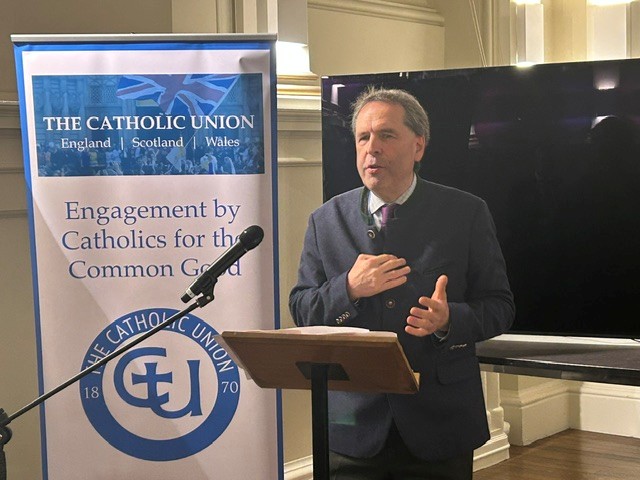
Read a speech by Professor Philip Booth given at a reception following the Catholic Union of Great Britain’s AGM 2026.
Public Engagement by the Catholic Bishops’ Conference of England and Wales. Professor Philip Booth, Director of Policy and Research at the Catholic Bishops’ Conference of England and Wales.
I would like to thank you for asking me to say a few words about public engagement by the Catholic Bishops’ Conference of England and Wales. I appreciate that you are standing, and you don’t wish to hear from me at length, so I will try to be brief.
Assisted suicide
I must, of course, start by talking about death of the assisted suicide bill. We have been working on this for over four years, realising what was likely to happen after a general election.
Catholic organisations up and down the country – care homes, the Catholic Medical Association, the Catholic Union and many others – as well as Catholics in parliament have undertaken a huge amount of work to oppose assisted suicide. We worked with non-Catholic allies, and the bishops themselves were steadfast in their opposition and encouraged the faithful to engage with parliamentarians. And this work succeeded.
The coalition that was built pointed to issues such as coercion, inadequate palliative care, very weak conscience clauses and the threats to our hospices and care homes.
Building that coalition, including with many of other faiths and none, was important. But it is important to note that a relatively small number of politicians opposed the bill on principle. That is a danger that I will come back to this at the end of my remarks.
Perhaps I can say something about language in relation to this issue. Confucius was reported to have said: “when words lose their meaning, people will lose their liberty”. We have a version of this with life issues – both abortion and assisted suicide – where euphemisms are used because the truth is too painful to confront.
The proposers of assisted suicide achieved a victory in ensuring that nearly everybody calls “assisted suicide” “assisted dying”. Allowing medical professions to help people end their own lives by taking lethal drugs is assisting with suicide. The phrase “assisted dying” has been widely adopted to try to sanitise the issue despite the fact that this was not the title of the bill, and despite the fact that “assisted suicide” is the accepted formal term for what the bill proposed.
We must work to reclaim the language.
Moving to the other end of life. For Day for Life this year, we took as our theme the wonder of life in the womb. And this was important. We must, and do, campaign relentlessly against abortion. But it is important not to become defined by what we oppose. Our key message is that we support the protection of and uphold the dignity of some of the most vulnerable people in society – the defenceless unborn baby and the parents of that baby. And that is why we oppose abortion, support parents who have experienced miscarriage and give all kinds of help to mothers who have become pregnant in difficult circumstances, including through the bishops’ day for life fund.
Other issues
Let me just give you a small sample of other issues – I will have to leave aside criminal justice, migration, human trafficking and a host of other things. We continued work on child poverty, and, after much campaigning, it was announced that the two-child cap on universal credit payments would be removed.
There has been a continual threat that Catholic schools would lose control of admissions’ policies, and amendments were proposed to the Child Wellbeing and Schools Bill to that effect. In the end, these amendments were rejected, so the general presumption that the state is there to support parents who choose a Catholic school for their children remains in place.
I will mention one further issue. Today falls between International Freedom of Religion and Belief Day and Red Wednesday later this month. Last week, Aid to the Church in Need’s report on Christian persecution was issued. The stories are harrowing. Around 400 million Christians live in tangible fear of persecution for practising their faith. What can we do? In a statement issued last week, Bishop James Curry asked us to pray for Christians facing persecution (including inserting appropriate prayers into the intercessions in parishes). He also asked people to sign Aid to the Church in Need’s petition asking those in authority to implement article 18 of the Universal Declaration on Human Rights: please do consider that. Bishop Curry also wrote to the new prime minister asking him to raise the case of Jimmy Lai, a Catholic and a UK citizen, whose family practise in this diocese, and who is unjustly held in prison in dire conditions in Hong Kong.
Before I make a final point, perhaps I can also acknowledge the work of the agencies of the Catholic Bishops’ Conference – Cafod, Caritas Social Action Network, Stella Maris, Missio and the Catholic Education Service. They, together with a whole range of Catholic organisations, including the Catholic Union, do so much to make the Catholic voice heard in the public square. And I also wish to thank my colleagues in Eccleston Square where there is a great team, as well as the bishops whom we support in their work.
My final point is that, when we look at some of the issues that face us, we can get a bit depressed. I think people accept that politics and policy is downstream of culture. As I suggested earlier, culture is often downstream of language. But, more importantly, culture is downstream of evangelisation and mission.
On that note, perhaps I can end with a quote from the conclusion of the PhD of Archbishop John Wilson which, I think, encapsulates this point perfectly. He wrote, nearly 30 years ago, after analysing failed campaigns on embryo experimentation and related issues: “Certainly, questions surrounding the appropriateness of communication and the adequate nature of argumentation are relevant…[However] A radical re-evangelisation of culture offers the fundamental response to bioethical questions, recalling society to an inner conviction of human life’s grandeur and dignity as the inviolable gift of God.”
In other words, the key to rebuilding a political culture that promotes the common good is evangelisation. We all know that there are significant signs of hope in this respect. That is a long-term perspective. But we are here for the long term.